Insights
Notes on trust in renting: the paperwork nobody can check any more, the fraud AI made free to produce, and what changes when a landlord can see proof instead of promises.
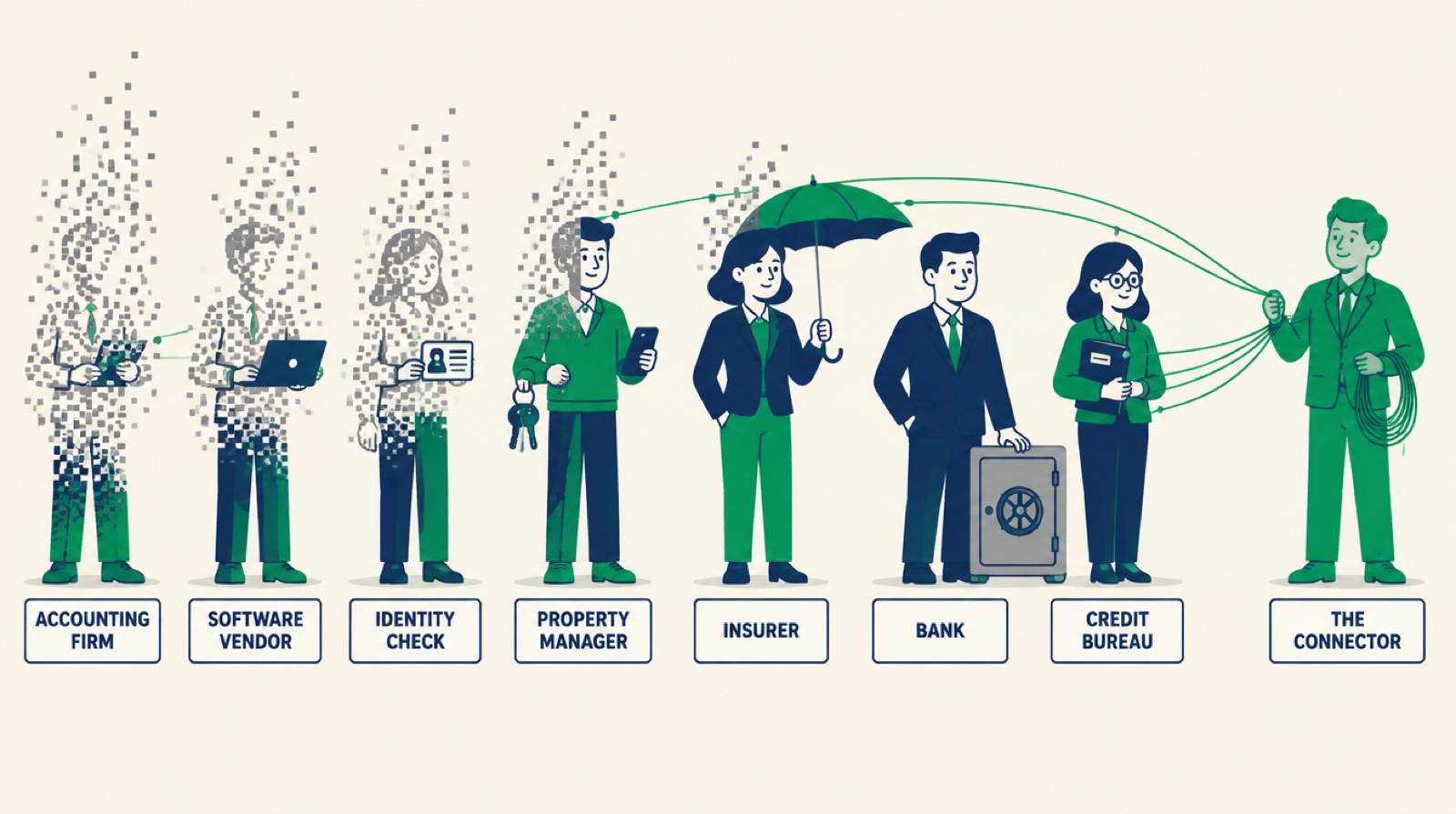
In the consumer world one company can win the whole relationship. In renting nobody can. The fight is for the position that gives small players big-company capability.
Current analysis

Current analysis
August 30, 2026
Landlords are still inspecting rental application packets. AI agents are submitting them. A generated application is a performance, and rent is an event.

Current analysis
July 1, 2026
Every financial domain built a way for identity to travel except rental, and about 87 percent of rent payments leave no credit trace.

Current analysis
July 1, 2026
As software gets faster, the compliance work that slows infrastructure down is what makes it defensible.

Current analysis
July 1, 2026
Rental discovery assumed renters would search. That assumption is being replaced, and verified is different from listed.

Current analysis
June 23, 2026
Rent runs 30 to 40 percent of household income for millions of renters, and most of it produces no credit signal at all.

Current analysis
June 9, 2026
Licences, bank sponsorships, carrier agreements and bureau relationships: what it actually takes to build the regulated plumbing.
Series 01: Security in the age of AI

Series 01: Security in the age of AI
July 1, 2026
The technique behind a well known consulting firm breach applies directly to property management software.

Series 01: Security in the age of AI
June 2, 2026
Synthetic identities generated by AI now pass standard tenant screening, and detection has not caught up.

Series 01: Security in the age of AI
May 19, 2026
Every third party integration is a place where trust can break. The more vendors you add, the more doors you open.

Series 01: Security in the age of AI
May 12, 2026
A twenty dollar breach worked because enterprise software assumed access would come at human speed. That is now a weakness.
Series 02: Automated commerce and the rental lease

Series 02: Automated commerce and the rental lease
August 18, 2026
The rails for AI spending are built. The judgment layer that decides whether a payment is correct is not.

Series 02: Automated commerce and the rental lease
July 1, 2026
When software executes a rental transaction and something goes wrong, the dispute needs an evidence record.

Series 02: Automated commerce and the rental lease
June 30, 2026
Automated checkout handles execution well. A residential lease needs governance, and governance is the transaction.

Series 02: Automated commerce and the rental lease
June 23, 2026
Automated systems do not travel between tools, so value moves to whoever owns the process underneath.

Series 02: Automated commerce and the rental lease
June 16, 2026
Several groups are racing to own the infrastructure that automated commerce runs on, and rental has no seat at the table.

Series 02: Automated commerce and the rental lease
June 16, 2026
Intelligence is getting cheap fast. The scarce asset is the regulated layer where an agent can actually act.

Series 02: Automated commerce and the rental lease
June 12, 2026
At a major 2026 product event, one company kept the surface and gave up the model. That choice shows where value sits.

Series 02: Automated commerce and the rental lease
May 26, 2026
The software that increasingly runs a business does not log in, does not have a seat, and does not pay for one.
 VFIntel